
Clonorchis Sinensis and Its Pathobiological Impact on Human Health: A Comprehensive Review
DOI:
https://doi.org/10.65139/w6n6jw60Keywords:
Clonorchiasis, hepatobiliary disease, hepatic inflammation, human infection, pathogenesis, cholangiocarcinoma, foodborne trematodeAbstract
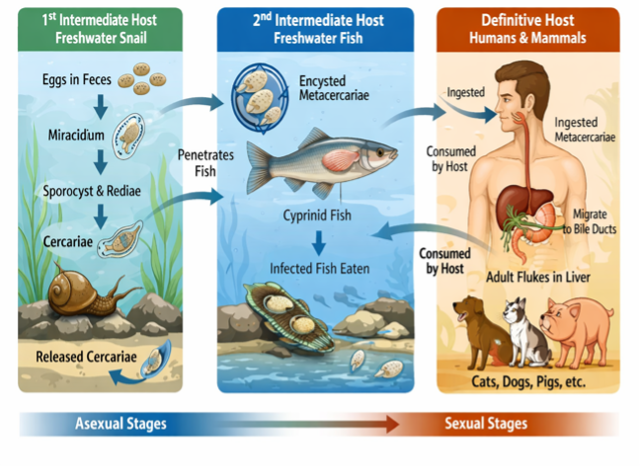
Clonorchiasis remains an important food-borne parasitic disease associated with hepatobiliary complications and long-term health consequences. Despite its public health significance, infections are often underdiagnosed due to mild or nonspecific symptoms. This review aims to summarize the epidemiology, life cycle, clinical manifestations, diagnostic approaches, and current strategies for the prevention and treatment of clonorchiasis. After ingestion, the parasite migrates to the bile ducts where it matures and can persist for many years. Mild infections may remain asymptomatic, whereas moderate to severe infections can cause hepatobiliary disorders such as abdominal pain, fatigue, bile duct obstruction, jaundice, and hepatomegaly. Clonorchis sinensis can infect a variety of mammals including humans, cats, dogs, pigs, and other piscivorous animals, which serve as reservoir hosts. Chronic infections may remain undetected for decades, contributing to delayed diagnosis and mismanagement. Accurate diagnosis can be achieved through microscopic, serological, and molecular methods. Prevention and control strategies include improved sanitation, food safety practices, public health education, and chemotherapy. Early diagnosis, effective treatment with antiparasitic drugs such as praziquantel, and strengthened preventive measures are crucial for controlling clonorchiasis in endemic regions. Enhanced public awareness and implementation of comprehensive health strategies can substantially reduce the burden of this neglected parasitic infection.
References
[1] Qian MB. Neglected tropical diseases and global burden of disease in China. Infect Dis Poverty. 2017;6(1):25. https://doi.org/10.1186/s40249-017-0237-y
[2] Kaminsky R, Maser P. Global impact of parasitic infections and the importance of parasite control. Front Parasitol. 2025;4:1546195. https://doi.org/10.3389/fpara.2025.1546195
[3] Fang YY, Chen YD, Li XM, Wu J, Zhang QM, Ruan CW. [Current prevalence of Clonorchis sinensis infection in endemic areas of China]. Zhongguo Ji Sheng Chong Xue Yu Ji Sheng Chong Bing Za Zhi. 2008;26(2):99-103, 109.
[4] Furst T, Keiser J, Utzinger J. Global burden of human food-borne trematodiasis: a systematic review and meta-analysis. Lancet Infect Dis. 2012;12(3):210-221. https://doi.org/10.1016/S1473-3099(11)70294-8
[5] Chen ER. Clonorchiasis in Taiwan. Southeast Asian J Trop Med Public Health. 1991;22 Suppl:184-185.
[6] Dai F, Hong SJ, Pak JH, Le TH, Choi SH, Na BK, et al. High Prevalence of Clonorchis sinensis and Other Zoonotic Trematode Metacercariae in Fish from a Local Market in Yen Bai Province, Northern Vietnam. Korean J Parasitol. 2020;58(3):333-338. https://doi.org/10.3347/kjp.2020.58.3.333
[7] Bahk YY, Shin EH, Cho SH, Ju JW, Chai JY, Kim TS. Prevention and Control Strategies for Parasitic Infections in the Korea Centers for Disease Control and Prevention. Korean J Parasitol. 2018;56(5):401-408. https://doi.org/10.3347/kjp.2018.56.5.401
[8] Qian M-B, Li H-M, Jiang Z-H, Yang Y-C, Lu M-F, Wei K, et al. Severe hepatobiliary morbidity is associated with Clonorchis sinensis infection: the evidence from a cross-sectional community study. PLoS neglected tropical diseases. 2021;15(1):e0009116. https://doi.org/10.1371/journal.pntd.0009116
[9] Kim T-S, Pak JH, Kim J-B, Bahk YY. Clonorchis sinensis, an oriental liver fluke, as a human biological agent of cholangiocarcinoma: a brief review. BMB reports. 2016;49(11):590-597. https://doi.org/10.5483/bmbrep.2016.49.11.109
[10] Qian M-B, Zhou C-H, Zhu H-H, Zhu T-J, Huang J-L, Chen Y-D, et al. From awareness to action: NIPD's engagement in the control of food-borne clonorchiasis. Advances in parasitology. 2020;110:245-267. https://doi.org/10.1016/bs.apar.2020.04.004
[11] Yoshida Y. Clonorchiasis—a historical review of contributions of Japanese parasitologists. Parasitology international. 2012;61(1):5-9. https://doi.org/10.1016/j.parint.2011.06.003
[12] Chai JY, Darwin Murrell K, Lymbery AJ. Fish-borne parasitic zoonoses: status and issues. Int J Parasitol. 2005;35(11-12):1233-1254. https://doi.org/10.1016/j.ijpara.2005.07.013
[13] Tang ZL, Huang Y, Yu XB. Current status and perspectives of Clonorchis sinensis and clonorchiasis: epidemiology, pathogenesis, omics, prevention and control. Infect Dis Poverty. 2016;5(1):71. https://doi.org/10.1186/s40249-016-0166-1
[14] Qian MB, Chen YD, Yan F. Time to tackle clonorchiasis in China. Infect Dis Poverty. 2013;2(1):4. https://doi.org/10.1186/2049-9957-2-4
[15] Qian M-B, Utzinger J, Keiser J, Zhou X-N. Clonorchiasis. The Lancet. 2016;387(10020):800-810. https://doi.org/10.1016/S0140-6736(15)60313-0
[16] Hong ST, Fang Y. Clonorchis sinensis and clonorchiasis, an update. Parasitol Int. 2012;61(1):17-24. https://doi.org/10.1016/j.parint.2011.06.007
[17] Lun ZR, Gasser RB, Lai DH, Li AX, Zhu XQ, Yu XB, et al. Clonorchiasis: a key foodborne zoonosis in China. Lancet Infect Dis. 2005;5(1):31-41. https://doi.org/10.1016/S1473-3099(04)01252-6
[18] Ma Y, Wang H. Epidemiological evolvement of Clonorchiasis sinensis in China for the past 60 years. Int J Med Parasit Dis. 2009;36(5):362-367.
[19] Doanh PN, Nawa Y. Clonorchis sinensis and Opisthorchis spp. in Vietnam: current status and prospects. Trans R Soc Trop Med Hyg. 2016;110(1):13-20. https://doi.org/10.1093/trstmh/trv103
[20] Hung NM, Madsen H, Fried B. Global status of fish-borne zoonotic trematodiasis in humans. Acta Parasitol. 2013;58(3):231-258. https://doi.org/10.2478/s11686-013-0155-5
[21] Sithithaworn P, Andrews RH, Nguyen VD, Wongsaroj T, Sinuon M, Odermatt P, et al. The current status of opisthorchiasis and clonorchiasis in the Mekong Basin. Parasitol Int. 2012;61(1):10-16. https://doi.org/10.1016/j.parint.2011.08.014
[22] Shin EH, Guk SM, Kim HJ, Lee SH, Chai JY. Trends in parasitic diseases in the Republic of Korea. Trends Parasitol. 2008;24(3):143-150. https://doi.org/10.1016/j.pt.2007.12.003
[23] Nontasut P, Thong TV, Waikagul J, Anantaphruti MT, Fungladda W, Imamee N, et al. Social and behavioral factors associated with Clonorchis infection in one commune located in the Red River Delta of Vietnam. Southeast Asian J Trop Med Public Health. 2003;34(2):269-273.
[24] Thi Cam TD, Yajima A, Viet KN, Montresor A. Prevalence, intensity and risk factors for clonorchiasis and possible use of questionnaires to detect individuals at risk in northern Vietnam. Transactions of the Royal Society of Tropical Medicine and Hygiene. 2008;102(12):1263-1268. https://doi.org/10.1016/j.trstmh.2008.06.002
[25] Vinh HQ, Phimpraphai W, Tangkawattana S, Smith JF, Kaewkes S, Dung DT, et al. Risk factors for Clonorchis sinensis infection transmission in humans in northern Vietnam: A descriptive and social network analysis study. Parasitol Int. 2017;66(2):74-82. https://doi.org/10.1016/j.parint.2016.11.018
[26] Yoo WG, Sohn WM, Na BK. Current status of Clonorchis sinensis and clonorchiasis in Korea: epidemiological perspectives integrating the data from human and intermediate hosts. Parasitology. 2022;149(10):1296-1305. https://doi.org/10.1017/S0031182022000798
[27] Kaewkes S. Taxonomy and biology of liver flukes. Acta Trop. 2003;88(3):177-186. https://doi.org/10.1016/j.actatropica.2003.05.001
[28] Fujino T, Ishii Y, Choi DW. The ultrastructural characterization of the tegument of Clonorchis sinensis (Cobbold, 1875) cercaria. Z Parasitenkd. 1979;60(1):65-76. https://doi.org/10.1007/BF00928972
[29] Control CfD, Prevention. Clonorchis: resources for health professionals. 2021.
[30] Kim J-H, Choi M-H, Bae YM, Oh J-K, Lim MK, Hong S-T. Correlation between discharged worms and fecal egg counts in human clonorchiasis. PLoS neglected tropical diseases. 2011;5(10):e1339. https://doi.org/10.1371/journal.pntd.0001339
[31] Bouvard V, Baan R, Straif K, Grosse Y, Secretan B, El Ghissassi F, et al. A review of human carcinogens—Part B: biological agents. The lancet oncology. 2009;10(4):321-322. https://doi.org/10.1016/s1470-2045(09)70096-8
[32] Rim HJ. Clonorchiasis: an update. J Helminthol. 2005;79(3):269-281. https://doi.org/10.1079/joh2005300
[33] Choi DW. Clonorchis sinensis: life cycle, intermediate hosts, transmission to man and geographical distribution in Korea. Arzneimittelforschung. 1984;34(9B):1145-1151.
[34] Chung PR, Soh CT. Snail-borne parasitic zoonoses in Korea. Southeast Asian J Trop Med Public Health. 1991;22 Suppl:391-395.
[35] Na BK, Pak JH, Hong SJ. Clonorchis sinensis and clonorchiasis. Acta Trop. 2020;203:105309. https://doi.org/10.1016/j.actatropica.2019.105309
[36] Tang J, Lin R, Zhu X. Animals infected with Clonorchis sinensis in China. Chin J Zoonoses. 2007;23(2):177-179.
[37] Fattakhov RG, Ushakov AV, Stepanova TF, Ianovich VA, Kopylov PV. [Epizootiological characteristics of clonorchiasis foci in the Amur River ecosystem in the Jewish autonomic region]. Med Parazitol (Mosk). 2012(4):15-18.
[38] Sohn WM. Fish-borne zoonotic trematode metacercariae in the Republic of Korea. Korean J Parasitol. 2009;47 Suppl(Suppl):S103-113. https://doi.org/10.3347/kjp.2009.47.S.S103
[39] Kim TI, Yoo WG, Kwak BK, Seok JW, Hong SJ. Tracing of the Bile-chemotactic migration of juvenile Clonorchis sinensis in rabbits by PET-CT. PLoS Negl Trop Dis. 2011;5(12):e1414. https://doi.org/10.1371/journal.pntd.0001414
[40] Rim HJ. The current pathobiology and chemotherapy of clonorchiasis. Kisaengchunghak Chapchi. 1986;24 Suppl:1-141. https://doi.org/10.3347/kjp.1986.24.suppl.1
[41] Qian MB, Chen YD, Fang YY, Xu LQ, Zhu TJ, Tan T, et al. Disability weight of Clonorchis sinensis infection: captured from community study and model simulation. PLoS Negl Trop Dis. 2011;5(12):e1377. https://doi.org/10.1371/journal.pntd.0001377
[42] Fedorova OS, Fedotova MM, Zvonareva OI, Mazeina SV, Kovshirina YV, Sokolova TS, et al. Opisthorchis felineus infection, risks, and morbidity in rural Western Siberia, Russian Federation. PLoS Negl Trop Dis. 2020;14(6):e0008421. https://doi.org/10.1371/journal.pntd.0008421
[43] Qiao T, Ma R-h, Luo X-b, Luo Z-l, Zheng P-m. Cholecystolithiasis is associated with Clonorchis sinensis infection. 2012;7(8):e42471. https://doi.org/https://doi.org/10.1371/journal.pone.0042471
[44] Sripa B, Kaewkes S, Intapan PM, Maleewong W, Brindley PJ. Food-borne trematodiases in Southeast Asia epidemiology, pathology, clinical manifestation and control. Adv Parasitol. 2010;72:305-350. https://doi.org/10.1016/S0065-308X(10)72011-X
[45] Chen M, Mott K. Progress in assessment of morbidity due to Fasciola hepatica infection: a review of recent literature. Tropical diseases bulletin. 1990;87.
[46] Hong S-T, Choi M-H, Kim C-H, Chung B-S, Ji Z. The Kato-Katz method is reliable for diagnosis of Clonorchis sinensis infection. Diagnostic microbiology and infectious disease. 2003;47(1):345-347. https://doi.org/10.1016/s0732-8893(03)00113-5
[47] Choi MH, Ge T, Yuan S, Hong ST. Correlation of egg counts of Clonorchis sinensis by three methods of fecal examination. Korean J Parasitol. 2005;43(3):115-117. https://doi.org/10.3347/kjp.2005.43.3.115
[48] Nie G, Wang T, Lu S, Liu W, Li Y, Lei J. Detection of Clonorchis sinensis circulating antigen in sera from Chinese patients by immunomagnetic bead ELISA based on IgY. PLoS One. 2014;9(12):e113208. https://doi.org/10.1371/journal.pone.0113208
[49] Huang SY, Zhao GH, Fu BQ, Xu MJ, Wang CR, Wu SM, et al. Genomics and molecular genetics of Clonorchis sinensis: current status and perspectives. Parasitol Int. 2012;61(1):71-76. https://doi.org/10.1016/j.parint.2011.06.008
[50] Kim EM, Verweij JJ, Jalili A, van Lieshout L, Choi MH, Bae YM, et al. Detection of Clonorchis sinensis in stool samples using real-time PCR. Ann Trop Med Parasitol. 2009;103(6):513-518. https://doi.org/10.1179/136485909X451834
[51] Wang X, Chen W, Huang Y, Sun J, Men J, Liu H, et al. The draft genome of the carcinogenic human liver fluke Clonorchis sinensis. Genome Biol. 2011;12(10):R107. https://doi.org/10.1186/gb-2011-12-10-r107
[52] Intapan PM, Thanchomnang T, Lulitanond V, Pongsaskulchoti P, Maleewong W. Detection of Opisthorchis viverrini in infected bithynid snails by real-time fluorescence resonance energy transfer PCR-based method and melting curve analysis. Parasitol Res. 2008;103(3):649-655. https://doi.org/10.1007/s00436-008-1026-0
[53] Chen Y, Wen T, Lai DH, Wen YZ, Wu ZD, Yang TB, et al. Development and evaluation of loop-mediated isothermal amplification (LAMP) for rapid detection of Clonorchis sinensis from its first intermediate hosts, freshwater snails. Parasitology. 2013;140(11):1377-1383. https://doi.org/10.1017/S0031182013000498
[54] Cai XQ, Yu HQ, Bai JS, Tang JD, Hu XC, Chen DH, et al. Development of a TaqMan based real-time PCR assay for detection of Clonorchis sinensis DNA in human stool samples and fishes. Parasitol Int. 2012;61(1):183-186. https://doi.org/10.1016/j.parint.2011.06.010
[55] Choi BI, Han JK, Hong ST, Lee KH. Clonorchiasis and cholangiocarcinoma: etiologic relationship and imaging diagnosis. Clin Microbiol Rev. 2004;17(3):540-552, table of contents. https://doi.org/10.1128/CMR.17.3.540-552.2004
[56] Choi MH, Park SK, Li Z, Ji Z, Yu G, Feng Z, et al. Effect of control strategies on prevalence, incidence and re-infection of clonorchiasis in endemic areas of China. PLoS Negl Trop Dis. 2010;4(2):e601. https://doi.org/10.1371/journal.pntd.0000601
[57] Lee JM, Lim HS, Hong ST. Hypersensitive reaction to praziquantel in a clonorchiasis patient. Korean J Parasitol. 2011;49(3):273-275. https://doi.org/10.3347/kjp.2011.49.3.273
[58] Xiao SH, Xue J, Xu LL, Zheng Q, Qiang HQ, Zhang YN. The in vitro and in vivo effect of tribendimidine and its metabolites against Clonorchis sinensis. Parasitol Res. 2009;105(6):1497-1507. https://doi.org/10.1007/s00436-009-1579-6
[59] Xue J, Xu LL, Qiang HQ, Zhang YN, Xiao SH. [Therapeutic effect of tribendimidine, artesunate and praziquantel administered to hamsters infected with Clonorchis sinensis]. Zhongguo Ji Sheng Chong Xue Yu Ji Sheng Chong Bing Za Zhi. 2009;27(3):215-218.
[60] Chai J-Y, Jung B-K, Hong S-J. Albendazole and mebendazole as anti-parasitic and anti-cancer agents: an update. The Korean journal of parasitology. 2021;59(3):189. https://doi.org/10.3347/kjp.2021.59.3.189
[61] Wu W, Qian X, Huang Y, Hong Q. A review of the control of clonorchiasis sinensis and Taenia solium taeniasis/cysticercosis in China. Parasitol Res. 2012;111(5):1879-1884. https://doi.org/10.1007/s00436-012-3152-y
[62] Qian MB. Clonorchiasis control: starting from awareness. Infect Dis Poverty. 2014;3:33. https://doi.org/10.1186/2049-9957-3-33
[63] Xin-Hua H, Zhi-Qi L, Yue-Yi F, Cai-Yun R, Xue-Jun Z, Di-Xuan L, et al. [Effect of comprehensive control in demonstration plot of clonorchiasis in Yangshan County, 2006-2009]. Zhongguo Xue Xi Chong Bing Fang Zhi Za Zhi. 2011;23(5):569-570, 574.
[64] Keiser J, Utzinger J. Food-borne trematodiases. Clin Microbiol Rev. 2009;22(3):466-483. https://doi.org/10.1128/CMR.00012-09
[65] Zhang J, Xia J, Zhu H, Lin W, Wu D-N, Wan L, et al. Final evaluation of the prevention and control plan of key parasitic diseases in Hubei Province, 2016-2019. 2023. https://doi.org/10.13604/j.cnki.46-1064/r.2023.05.05
Downloads
Published
Data Availability Statement
Data will be made available on request.
Issue
Section
Categories
License
Copyright (c) 2026 Asra Nawab, Dr. Ghulam Murtaza, Iqra Moomina, Bareera Fatima, Shazia Parveen, Nimra Akhtar (Author)

This work is licensed under a Creative Commons Attribution 4.0 International License.
This work is licensed under a Creative Commons Attribution 4.0 International License.
How to Cite