
Effects of Dietary Mentha piperita Supplementation on Growth Performance, Feed Utilization, and Proximate Composition of Labeo rohita Fingerlings
DOI:
https://doi.org/10.65139/g9ne6553Keywords:
Labeo rohita, Mentha piperita, peppermint supplementation, growth performance, feed conversion ratio, specific growth rate, proximate composition, aquaculture nutritionAbstract
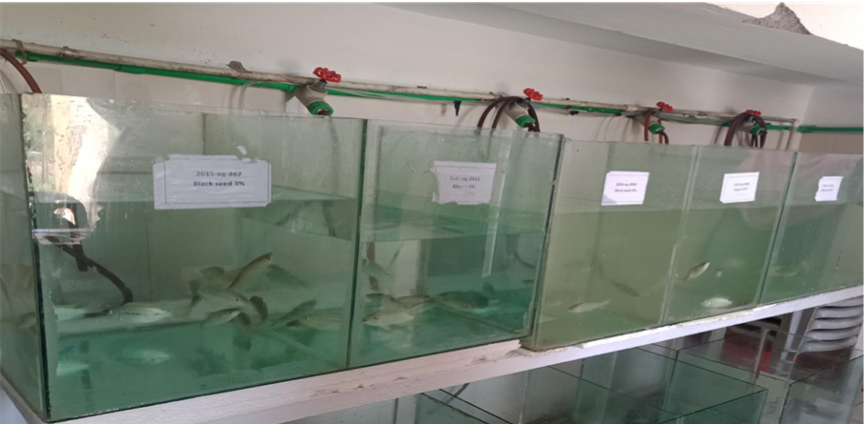
Fish is a preferred and affordable source of high-quality animal protein for humans. Labeo rohita is one of the most important Indian major carps cultured in polyculture systems. Mentha piperita (peppermint) is a medicinal plant belonging to the Lamiaceae family, with bioactive compounds that may enhance growth and feed utilization in fish. The present study investigated the effects of dietary peppermint supplementation on growth performance, feed utilization, and proximate body composition of L. rohita. Fingerlings (n = 10 per tank) were acclimatized for 4–6 days before the 28-day experimental trial. Four dietary treatments were prepared: T0 (control, 0 g/kg), T1 (100 g/kg), T2 (200 g/kg), and T3 (300 g/kg) peppermint supplementation. Growth performance parameters, including weight gain, fork length, total length, and specific growth rate (SGR), were measured weekly. Feed conversion ratio (FCR) and body composition (moisture, crude protein, crude fat, ash) were also evaluated. Results indicated that dietary peppermint significantly improved growth performance of L. rohita. Weight gain, total length, fork length, and SGR were highest in T3 (16.94 ± 1.954 g, 9.74 ± 0.492 cm, 6.79 ± 0.643 cm, 1.71 ± 0.583, respectively). FCR was lowest in T3 (best feed utilization), while moisture and crude fat were highest in T2 (75.51 ± 0.05%, 1.32 ± 0.04%), and crude protein and ash content were highest in T3 (22.26 ± 0.05%, 0.98 ± 0.04%). These results suggest that dietary peppermint supplementation, particularly at 300 g/kg, enhances growth performance, feed efficiency, and body composition of L. rohita. Data were expressed as mean ± SD, and statistical differences among treatments were determined using one-way ANOVA followed by Tukey’s post hoc test.
References
Ababouch, L. and I. Karunasagar. 2013. Global Fisheries and Aquaculture: Opportunities and Challenges. Int. J. Fish. Aquat. Stud. 6:56-59.
Abou Zaid, A. A., Mohammed, N. H., Elshafey, A. E., Hussein, E. E., El-Gamal, A. M., & Abo-Al-Ela, H. G. (2025). Mentha piperita Supplementation Promotes Growth, Immunity, and Disease Resistance in Nile tilapia Against Aeromonas hydrophila. Pathogens, 14(4), 378. https://doi.org/10.3390/pathogens14040378. DOI: https://doi.org/10.3390/pathogens14040378
Adel, M., R. Safari., R. Pourgholam., J. Zorriehzahra and M.A. Esteban. 2015. Dietary peppermint (Mentha piperita) extracts promote growth performance and increase the main humoral immune parameters (both at mucosal and systemic level) of Caspian brown trout (Salmo trutta caspius Kessler, 1877). Fish shellfish Immunol. 47:623-629. DOI: https://doi.org/10.1016/j.fsi.2015.10.005
Aguiar, G.A.C.C., C.L.S. Carneiro, D.A.V. Campelo, R.C.T. Rusth, J.F.R. Maciel, B. Baldisserotto, J.A.S. Zuanon, A.V. Oliveira, M.G.A. Oliveira, M.B.D. Freitas, W.M. Furuya and A.L. Salaro. 2023. Effects of dietary peppermint (Mentha piperita) essential oil on growth performance, plasma biochemistry, digestive enzyme activity, and oxidative stress responses in juvenile Nile tilapia (Oreochromis niloticus). Fishes. 8(7):374. https://doi.org/10.3390/fishes8070374. DOI: https://doi.org/10.3390/fishes8070374
Akhtar S, Zahoor I, Yahya S, Waseem N, Khan S, et al. (2020) Effect of phytase supplementation on Labeo rohita fingerlings that are fed by phytase supplemented ddgs based diet. Int J Aquac Fish Sci. 6(3): 61-67. 10.17352/2455-8400.000058. DOI: https://doi.org/10.26480/bda.02.2020.81.86
Bhattacharya, S., P. Sardar, N.P. Sahu, N. Shamna, M. Jayant, M.K. Maiti and A. Sundararajan. 2024. Dietary pineapple peel ethanolic extract alleviates crowding stress in Labeo rohita fingerlings with enhancement of growth performance and IGF-1 expression, physio-biochemical profile, antioxidant status and immunological responses. Anim. Feed Sci. Technol. 320:116200. 10.1016/j.anifeedsci.2024.116200. DOI: https://doi.org/10.1016/j.anifeedsci.2024.116200
Chrysohoou, C., D.B. Panagiotakos, C. Pitsavos, J. Skoumas, X. Krinos, Y. Chloptsios and C. Stefanadis. 2007. Long-term fish consumption is associated with protection against arrhythmia in healthy persons in a Mediterranean region - The ATTICA study. Am. J. Clin. Nutr. 85:1385-1391. DOI: https://doi.org/10.1093/ajcn/85.5.1385
Cuesta, A., J. Meseguer and M. A. Esteban. 2004. Total serum immunoglobulin M levels are affected by immunomodulators in Sea bream (Sparus aurata L.). Vet. Immunol. Immunopathol. 101:203-210. DOI: https://doi.org/10.1016/j.vetimm.2004.04.021
De Silva, S.S. and M.R. Hassan. 2007. Feed and Fertilizers: The key to long-term sustainability of Asian aquaculture. Aquaculture, 17:39-40.
Faisal M, Hussain SM, Sarker PK, Ali S, Al-Ghanim KA and Yousaf Z (2024) Utilization of Moringa oleifera leaf meal as a protein source in diets for Cirrhinus mrigala: effects on growth, body composition, and hematology. Front. Sustain. Food Syst. 8:1405614. doi: 10.3389/fsufs.2024.1405614. DOI: https://doi.org/10.3389/fsufs.2024.1405614
FAO, 2006. Fisheries department, Fisheries information, data and statistical unit. Intern. Pp.147.
FAO, 2017. National Aquaculture Sector Overview: Pak. Fish. Aqua. Dept. Pp.154.
Johnsson E, Harris C and Drewnowski A (2025) Nutrient density and affordability of aquatic foods in the FAO uFISH database assessed using Nutrient Rich Food (NRF) indices. Front. Nutr. 12:1675142. https://doi.org/10.3389/fnut.2025.1675142. DOI: https://doi.org/10.3389/fnut.2025.1675142
Lim, H.K., H.S. Han and J.W. Hur. 2021. Effects of water temperature changes on oxygen consumption and hematological factors in olive flounder Paralichthys olivaceus. Fisheries and Aquatic Sciences. 24(2):99-107. DOI:10.47853/FAS.2021.e10. DOI: https://doi.org/10.47853/FAS.2021.e10
Malik, S., Hussain, S., & Waqas, M. S. (2020). Effect of water quality and different meals on growth of Catla catla and Labeo rohita. Big Data in Water Resources Engineering, 1(1), 1–5. DOI:10.26480/bdwre.01.2020.04.08. DOI: https://doi.org/10.26480/bdwre.01.2020.04.08
Misra, C. K., B. K. Das, S. C. Mukherjee and P. K. Meher. 2006. The immunomodulatory effects of tuftsin on the non-specific immune system of Indian Major carp (Labeo rohita). Fish Shellfish Immun. 20:728-738. DOI: https://doi.org/10.1016/j.fsi.2005.09.004
Mohsin M, Yin H and Mehak A (2024) Sustainable solutions: exploring risks and strategies in Pakistan's seafood trade for marine conservation. Front. Mar. Sci. 11:1420755. DOI:10.3389/fmars.2024.1420755. DOI: https://doi.org/10.3389/fmars.2024.1420755
Nobakht, A. and Y. Mehmannavaz. 2010. Investigation the effects of using of Thymus vulgaris, Lamiaceae Mentha piperita, Oreganum valgare medicinal plants on performance, egg quality, blood and immunity parameters of laying hens. Ir. J. Anim. Sci. 41:129-136.
Noreen S, Hashmi B, Aja PM and Atoki AV (2025) Health benefits of fish and fish by-products—a nutritional and functional perspective. Front. Nutr. 12:1564315. doi: 10.3389/fnut.2025.1564315. DOI: https://doi.org/10.3389/fnut.2025.1564315
Paknejad H, Hosseini Shekarabi SP, Shamsaie Mehrgan M, Hajimoradloo A, Khorshidi Z, Rastegari S. Dietary peppermint (Mentha piperita) powder affects growth performance, hematological indices, skin mucosal immune parameters, and expression of growth and stress-related genes in Caspian roach (Rutilus caspicus). Fish Physiol Biochem. 2020 Oct;46(5):1883-1895. https://doi.org/10.1007/s10695-020-00839-z. DOI: https://doi.org/10.1007/s10695-020-00839-z
Singh, B., Nishad, Y., Devi, B. N., Damle, D. K., Panda, K., Lal, J., Ngasotter, S., & Tameshwar. (2026). Effects of dietary supplementation of peppermint (Mentha piperita) on growth, survival and haemato-biochemical profile of common carp (Cyprinus carpio) fingerlings. Journal of Fisheries, 14(2), 142203. https://doi.org/10.17017/j.fish.1152. DOI: https://doi.org/10.17017/j.fish.1152
Sujatha, K., A.A. Joice and P.S. Kumaar. 2013. Total protein and lipid content in edible tissues of fishes from Kasimodu fish landing centre, Chennai, Tamilnadu. Eur. J. Exp. Biol. 3:252-257.
Sutili, F.J., D.M. Gatlin, B.M. Heinzmann and B. Baldisserotto. 2017. Plant essential oils as fish diet additives: benefits on fish health and stability in feed. Rev. Aquac. 3:1. https://doi.org/10.1111/raq.12197. DOI: https://doi.org/10.1111/raq.12197
Talpur, A.D. 2014. Mentha piperita (Peppermint) as feed additive enhanced growth performance, survival, immune response and disease resistance of Asian sea bass, Lates calcarifer (Bloch) against Vibrio harveyi infection. Aquaculture, 420:71-78. DOI: https://doi.org/10.1016/j.aquaculture.2013.10.039
Tan, X., Z. Sun, S. Chen, Z. Huang, C. Zhou, C. Zou, Q. Liu, H. Ye, H. Lin and C. Ye. 2017. Effects of dietary dandelion extracts on growth performance, body composition, plasma biochemical parameters, immune responses and disease resistance of juvenile golden pompano Trachinotus ovatus. Fish Shellfish Immunol. 66:198-206. https://doi.org/10.1016/j.fsi.2017.05.028. DOI: https://doi.org/10.1016/j.fsi.2017.05.028
Umer, K., and M. Ali. 2009. Replacement of fishmeal with blend of canola meal and corn gluten meal, and an attempt to find alternate source of milk fat for rohu (Labeo rohita). Pak. J. Zool. 4:469-474.
Yılmaz, S., A.S. Akay and E. Gumus. 2008. Fisheries sector in Turkish economy and marketing of fishery products. J. Akdeniz. Uni. Facul. Agri. 21:265-272.
Zhang, K., Ye, Z., Qi, M., Cai, W., Saraiva, J.L., Wen, Y., Liu, G., Zhu, Z., Zhu, S. and Zhao, J. (2025), Water Quality Impact on Fish Behavior: A Review From an Aquaculture Perspective. Rev Aquac, 17: e12985. https://doi.org/10.1111/raq.12985. DOI: https://doi.org/10.1111/raq.12985
Downloads
Published
Data Availability Statement
The data supporting the findings of this study are included within the manuscript. Additional raw data may be made available from the corresponding author upon reasonable request.
URN
License
Copyright (c) 2026 Sania Ramzan, Saba Malik, Amara Akhtar, Hafiza Sadia, Sheeba Riaz, Namrah, Ahmad Ali, Iqra Bibi (Author)

This work is licensed under a Creative Commons Attribution 4.0 International License.
This work is licensed under a Creative Commons Attribution 4.0 International License.
How to Cite