
Spatial Distribution Modeling of Stegomyia aegypti (Diptera: Culicidae) under Current and Future Climate Scenarios in Okara City, Punjab, Pakistan
DOI:
https://doi.org/10.65139/v7wpzt72Keywords:
Stegomyia aegypti, dengue vector, species distribution modeling, MaxEnt, climate change, SSP scenariosAbstract
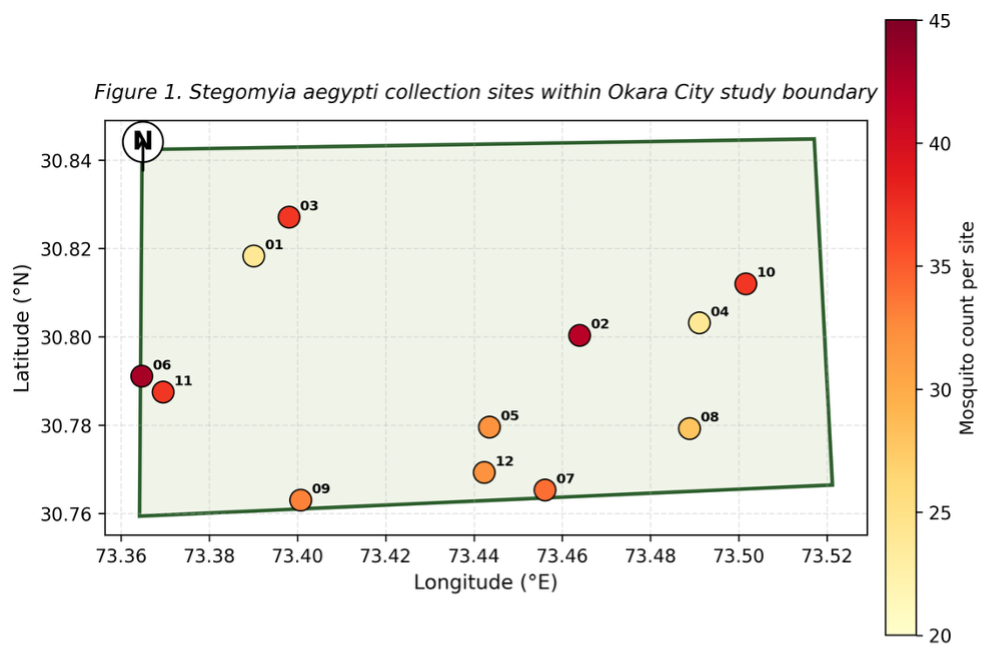
Dengue fever is a rapidly spreading vector-borne disease in Pakistan, with Stegomyia aegypti (formerly Aedes aegypti) as its primary mosquito vector. Okara City, located in Punjab Province, has experienced recurring dengue outbreaks, yet systematic spatial risk mapping of the vector remains limited. This study used a MaxEnt-based species distribution modeling (SDM) approach to map the current habitat suitability of St. aegypti in Okara City and to project changes in suitability under two future climate scenarios, SSP245 (moderate emissions) and SSP585 (high emissions), for the years 2050 and 2070. Mosquito occurrence data were collected from 12 geo-referenced sites within the urban and peri-urban boundary of Okara City (132.56 km²). Environmental predictors included the urban built-up index, distance to standing water, mean annual temperature, NDVI, annual rainfall, and distance to the road. The model showed excellent discriminatory performance. Under current conditions, 47.38 km² (35.7%) of the city boundary was classified as high-suitability habitat. Future projections indicated a progressive increase in high-suitability area under both SSP pathways, reaching up to 95.17 km² (71.8%) under SSP585 by 2050. Urban intensity and proximity to standing water were identified as the strongest predictors of vector occurrence. These findings provide spatially explicit risk information for dengue surveillance and vector control prioritization in Okara City.
References
Bhatt, S., Gething, P.W., Brady, O.J., Messina, J.P., Farlow, A.W., Moyes, C.L., et al. (2013). The global distribution and burden of dengue. Nature, 496(7446), 504-507. https://doi.org/10.1038/nature12060 DOI: https://doi.org/10.1038/nature12060
Brady, O.J., Johansson, M.A., Guerra, C.A., Bhatt, S., Golding, N., Pigott, D.M., et al. (2013). Modelling adult Aedes aegypti and Aedes albopictus survival at different temperatures in laboratory and field settings. Parasites & Vectors, 6, 351. https://doi.org/10.1186/1756-3305-6-351 DOI: https://doi.org/10.1186/1756-3305-6-351
Ebi, K.L. & Nealon, J. (2016). Dengue in a changing climate. Environmental Research, 151, 115-123. https://doi.org/10.1016/j.envres.2016.07.026 DOI: https://doi.org/10.1016/j.envres.2016.07.026
Elith, J., Phillips, S.J., Hastie, T., Dudík, M., Chee, Y.E., & Yates, C.J. (2011). A statistical explanation of MaxEnt for ecologists. Diversity and Distributions, 17(1), 43-57. https://doi.org/10.1111/j.1472-4642.2010.00725.x DOI: https://doi.org/10.1111/j.1472-4642.2010.00725.x
Fatima, S.H., Atif, S., Rasheed, S.B., Zaidi, F., & Hussain, E. (2016). Species distribution modelling of Aedes aegypti in two dengue-endemic regions of Pakistan. Tropical Medicine and International Health, 21(3), 427-436. https://doi.org/10.1111/tmi.12664 DOI: https://doi.org/10.1111/tmi.12664
Gubler, D.J. (2011). Dengue, urbanization and globalization: the unholy trinity of the 21st century. Tropical Medicine and Health, 39(4 Suppl), 3-11. https://doi.org/10.2149/tmh.2011-S05 DOI: https://doi.org/10.2149/tmh.2011-S05
Kraemer, M.U.G., Sinka, M.E., Duda, K.A., Mylne, A.Q.N., Shearer, F.M., Barker, C.M., et al. (2015). The global distribution of the arbovirus vectors Aedes aegypti and Ae. albopictus. eLife, 4, e08347. https://doi.org/10.7554/eLife.08347 DOI: https://doi.org/10.7554/eLife.08347
O’Neill, B.C., Tebaldi, C., van Vuuren, D.P., Eyring, V., Friedlingstein, P., Hurtt, G., et al. (2016). The Scenario Model Intercomparison Project (ScenarioMIP) for CMIP6. Geoscientific Model Development, 9(9), 3461-3482. https://doi.org/10.5194/gmd-9-3461-2016 DOI: https://doi.org/10.5194/gmd-9-3461-2016
Phillips, S.J., Anderson, R.P., & Schapire, R.E. (2006). Maximum entropy modeling of species geographic distributions. Ecological Modelling, 190(3-4), 231-259. https://doi.org/10.1016/j.ecolmodel.2005.03.026 DOI: https://doi.org/10.1016/j.ecolmodel.2005.03.026
Phillips, S.J. & Dudík, M. (2008). Modeling of species distributions with Maxent: new extensions and a comprehensive evaluation. Ecography, 31(2), 161-175. https://doi.org/10.1111/j.0906-7590.2008.5203.x DOI: https://doi.org/10.1111/j.0906-7590.2008.5203.x
Rasheed, S.B., Butlin, R.K., & Boots, M. (2013). A review of dengue as an emerging disease in Pakistan. Public Health, 127(1), 11-17. https://doi.org/10.1016/j.puhe.2012.09.006 DOI: https://doi.org/10.1016/j.puhe.2012.09.006
Sarfraz, M.S., Tripathi, N.K., Faruque, F.S., Bajwa, U.I., Kitamoto, A., & Souris, M. (2014). Mapping urban and peri-urban breeding habitats of Aedes mosquitoes using a fuzzy analytical hierarchical process based on climatic and physical parameters. Geospatial Health, 8(3), S685-S697. https://doi.org/10.4081/gh.2014.297 DOI: https://doi.org/10.4081/gh.2014.297
WHO (2012). Global Strategy for Dengue Prevention and Control 2012 to 2020. World Health Organization, Geneva.
Allouche, O., Tsoar, A., & Kadmon, R. (2006). Assessing the accuracy of species distribution models: prevalence, kappa and the true skill statistic (TSS). Journal of Applied Ecology, 43(6), 1223-1232. https://doi.org/10.1111/j.1365-2664.2006.01214.x DOI: https://doi.org/10.1111/j.1365-2664.2006.01214.x
Fick, S.E. & Hijmans, R.J. (2017). WorldClim 2: new 1 km spatial resolution climate surfaces for global land areas. International Journal of Climatology, 37(12), 4302-4315. https://doi.org/10.1002/joc.5086 DOI: https://doi.org/10.1002/joc.5086
Downloads
Published
Versions
- 2026-09-01 (2)
- 2026-08-13 (1)
Data Availability Statement
The data supporting the findings of this study are available from the corresponding author upon reasonable request.
Issue
Section
Categories
URN
License
Copyright (c) 2026 Saliha Asif, Maryam Riasat, Rumaisa Ashraf

This work is licensed under a Creative Commons Attribution 4.0 International License.
This work is licensed under a Creative Commons Attribution 4.0 International License.
How to Cite