
Oral administration of Fumaria officinalis alleviates Nephrotoxicity and improves behavior in Japanese quails
DOI:
https://doi.org/10.65139/76ddxr40Keywords:
Toluene, Nephrotoxicity, Oxidative Stress, Antioxidant Enzymes, Renal ProtectionAbstract
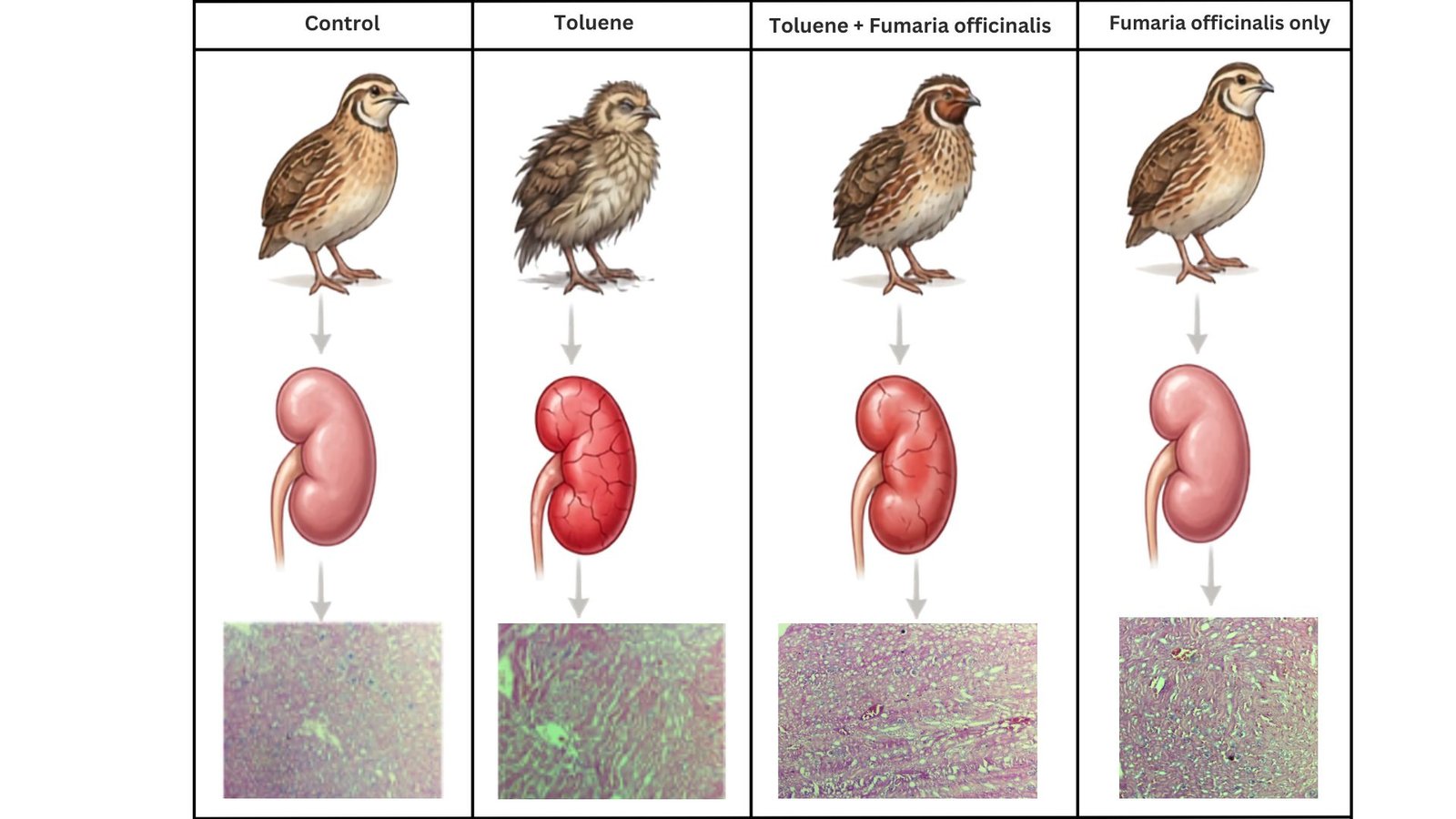
Aromatic hydrocarbons (AHCs) are crucial in petroleum-based transportation and consumer product manufacturing, but their accumulation in the body poses serious threats. Toluene, an important aromatic hydrocarbon, can cause oxidative stress and structural damage in the liver, kidney, and brain due to its lipophilic nature. Fumaria officinalis, an antioxidant with flavonoids and alkaloids, has been shown to protect renal diseases. The aim of the study is to demonstrate the beneficial effects of F. officinalis in general performance and reducing nephrotoxicity caused by toluene of Japanese quail. After a period of acclimation, sixteen Japanese quails, weighing between 100 and 140g, were used in the experiment. Four equal groups of birds were created: one group was given tap water and standard food; another group was exposed to toluene (0.2 mL/kg) in distilled water; a combination treatment of toluene (0.2 mL/kg) and F. officinalis (150 mg/kg B.W.) was given to the third group; and F. officinalis (150 mg/kg B.W.) was given to the fourth group. After a month, the birds were slaughtered, and blood samples were collected for analysis. The toluene-exposed group showed a significant increase in uric acid, creatinine, and biliverdin levels, a decline in albumin levels, and a decrease in body weight gain. The enzyme activity of superoxide dismutase and catalase was significantly lower in the toluene group. Furthermore, F. officinalis improved toluene-induced reductions in alertness, feeding activity, crowing, mating activity, and overall behavioral performance. This suggests that F. officinalis protects quails' kidneys against the toxicity of toluene.
References
Abdel-Salam, O. M. E., Sleem, A. A., & Shaffie, N. M. (2020). Antioxidant and anti-inflammatory effects of toluene exposure in rats. Environmental Science and Pollution Research, 27(5), 5151–5161.DOI: 10.21608/ejchem.2022.135813.5983. DOI: https://doi.org/10.21608/ejchem.2022.135813.5983
Abou-Zeid, S. M., Abdel-Rahman, M. A., & Sharaf, H. A. (2018). Effect of toluene inhalation on antioxidant status and the protective role of quercetin in rats. Biochemistry and Cell Biology, 96(6), 676–684. doi: 10.1080/09674845.2008.11732801. DOI: https://doi.org/10.1080/09674845.2008.11732801
Abduljalel, M. E., & Al-Saadi, R. N. (2022). Toxicopathological effect of benzene, toluene, ethylbenzene, and xylenes (BTEX) as a mixture and the protective effect of citicoline in male rats following 90-day oral exposure. REDVET-Revista electrónica de Veterinaria, 23(3).
Tienda-Vázquez, M. A., Morreeuw, Z. P., Sosa-Hernández, J. E., Cardador-Martínez, A., Sabath, E., Melchor-Martínez, E. M., ... & Parra-Saldívar, R. (2022). Nephroprotective plants: a review on the use in pre-renal and post-renal diseases. Plants, 11(6), 818. https://doi.org/10.3390/plants11060818. DOI: https://doi.org/10.3390/plants11060818
El-Hagrasy, A. M. A., Karrout, R. H., Mcguinness, A. L., Albutain, T. Z. A. M., Khalifa, D., Khalil, F. M. H. A., ... & Alaradi, M. (2025). Investigating the general effects of different types of toluene exposure on the health of workers: an integrative review of the literature. BMJ Public Health, 3(1). https://doi.org/10.1136/bmjph-2024-001046. DOI: https://doi.org/10.1136/bmjph-2024-001046
Aoiadni, N., Ayadi, H., Jdidi, H., Naifar, M., Maalej, S., Makni, F. A., ... & Koubaa, F. G. (2021). Flavonoid-rich fraction attenuates permethrin-induced toxicity by modulating ROS-mediated hepatic oxidative stress and mitochondrial dysfunction ex vivo and in vivo in rat. Environmental Science and Pollution Research, 28(8), 9290-9312. https://doi.org/10.1007/s11356-020-11250-9. DOI: https://doi.org/10.1007/s11356-020-11250-9
Daehn, I. S. (2018). Glomerular endothelial cell stress and cross-talk with podocytes in early diabetic kidney disease. Frontiers in medicine, 5, 76. https://doi.org/10.3389/fmed.2018.00076. DOI: https://doi.org/10.3389/fmed.2018.00113
Brieger, K., Schiavone, S., Miller Jr, F. J., & Krause, K. H. (2012). Reactive oxygen species: from health to disease. Swiss medical weekly, 142(3334), w13659-w13659. https://doi.org/10.4414/smw.2012.13659. DOI: https://doi.org/10.4414/smw.2012.13659
Rajput, S. K., Singh, S., & Bhardwaj, R. (2025). Toluene toxicity: Outline, management, and prognosis. In Hazardous Chemicals (pp. 391-404). Academic Press. https://doi.org/10.1016/B978-0-323-95235-4.00052-9. DOI: https://doi.org/10.1016/B978-0-323-95235-4.00052-9
Moawad, R. S., Abd El Fattah, E. R., & Alsemeh, A. E. (2021). Deleterious effect of toluene on rat cerebrum cortex and the exert effect of resveratrol:(Histological, immunohistochemical and ultrastructural study). Egyptian Journal of Histology, 44(3), 855-872. https://doi.org/10.21608/ejh.2021.71825.1459. DOI: https://doi.org/10.21608/ejh.2021.71825.1459
Sirotkin, A. V., Tarko, A., Kotwica, J., Mlyncek, M., Alwasel, S., Nitrayova, S., & Harrath, A. H. (2023). Three medicinal plants affecting human ovarian cell viability, hormone release, and response to environmental contaminant toluene. Physiological Research, 72(2), 259. https://doi.org/10.33549/physiolres.934986. DOI: https://doi.org/10.33549/physiolres.934986
Tumilaar, S. G., Hardianto, A., Dohi, H., & Kurnia, D. (2024). A comprehensive review of free radicals, oxidative stress, and antioxidants: Overview, clinical applications, global perspectives, future directions, and mechanisms of antioxidant activity of flavonoid compounds. Journal of Chemistry, 2024(1), 5594386. https://doi.org/10.1155/2024/5594386. DOI: https://doi.org/10.1155/2024/5594386
Firdani, F., Djaja, I. M., & Hermawati, E. (2019, October). Environmental Health Risk Assessment of Toluene Exposure. In AIPHC 2019: Proceedings of the Third Andalas International Public Health Conference, AIPHC 2019, 10-11th October 2019, Padang, West Sumatera, Indonesia (p. 114). European Alliance for Innovation. http://dx.doi.org/10.4108/eai.9-10-2019.2297184. DOI: https://doi.org/10.4108/eai.9-10-2019.2297184
Ben Attia, T., López-Maldonado, E. A., Galai, S., Bel Haj Kacem, L., & Mhamdi, A. (2025). Nephrotoxic effects of combined exposure to 85 dB (a) noise and 300 ppm toluene in Wistar rats: biochemical and histopathological analysis. Toxicology Research, 14(4), tfaf116. https://doi.org/10.1093/toxres/tfaf116. DOI: https://doi.org/10.1093/toxres/tfaf116
Kumar, S., Sharma, A. K., & Kamboj, A. (2017). Fumaria parviflora Lam.(Fumitory): A traditional herbal medicine with modern evidence. Asian j pharm pharmacol, 3(6), 200-207.
Khalil, H., Hassaneine, H., El-Sheikh, A. A., & Abdelbary, A. M. (2021). Evaluation of The Role of Buffalo Milk on Acute Toluene Induced Hepatotoxicity and Nephrotoxicity in Adult Male Albino Rats. Zagazig Journal of Forensic Medicine and Toxicology, 19(2), 31-48. https://doi.org/10.21608/zjfm.2021.71515.1074. DOI: https://doi.org/10.21608/zjfm.2021.71515.1074
Alsawaf, S., Alnuaimi, F., Afzal, S., Thomas, R. M., Chelakkot, A. L., Ramadan, W. S., ... & Vazhappilly, C. G. (2022). Plant flavonoids on oxidative stress-mediated kidney inflammation. Biology, 11(12), 1717. https://doi.org/10.3390/biology11121717. DOI: https://doi.org/10.3390/biology11121717
Balamurugan, V., Fatima, S., & Velurajan, S. (2019). A guide to phytochemical analysis. International Journal of Advance Research and Innovative Ideas in Education, 5(1), 236-245.
Armenta-Reséndiz, M., Ríos-Leal, E., Rivera-García, M. T., López-Rubalcava, C., & Cruz, S. L. (2019). Structure-activity study of acute neurobehavioral effects of cyclohexane, benzene, m-xylene, and toluene in rats. Toxicology and Applied Pharmacology, 376, 38-45. https://doi.org/10.1016/j.taap.2019.05.016. DOI: https://doi.org/10.1016/j.taap.2019.05.016
Akbari, B., Baghaei‐Yazdi, N., Bahmaie, M., & Mahdavi Abhari, F. (2022). The role of plant‐derived natural antioxidants in reduction of oxidative stress. BioFactors, 48(3), 611-633. https://doi.org/10.1002/biof.1831. DOI: https://doi.org/10.1002/biof.1831
Karak, P. (2019). Biological activities of flavonoids: An overview. Int. J. Pharm. Sci. Res, 10(4), 1567-1574. 10.13040/IJPSR.0975-8232.10(4).1567-74.
Ma, Y., Wang, L., & Huang, Y. (2023). Flavonoids as potential therapeutic agents for oxidative stress-related kidney diseases. Frontiers in Pharmacology, 14, 1185634. https://doi.org/10.2174/1381612826666200826164322. DOI: https://doi.org/10.2174/1381612826666200826164322
Folarin, O., Omirinde, J., Gilbert, T., & Afodun, A. (2025). Thinner induced multiple organ toxicities in Wistar rats: ameliorative role of vitamin E (alpha-tocopherol). Turkish Journal of Science and Technology, 20(1), 339-354. https://doi.org/10.55525/tjst.1623887. DOI: https://doi.org/10.55525/tjst.1623887
Joshi, D. R., & Adhikari, N. (2019). An overview on common organic solvents and their toxicity. J. Pharm. Res. Int, 28(3), 1-18. DOI: 10.9734/JPRI/2019/v28i330203. DOI: https://doi.org/10.9734/jpri/2019/v28i330203
Basak Erdemli-Kose, S., Erol, Z., Garli, S., & Sahindokuyucu-Kocasari, F. (2021). The protective effect of p-coumaric acid on toluene-induced hepatotoxicity nephrotoxicity and neurotoxicity in rats. Revista colombiana de ciencia animal recia, 13(1), 37-43. 10.24188/recia.v13.n1.2021.843 DOI: https://doi.org/10.24188/recia.v13.n1.2021.843
Rao, C. V., Verma, A. R., Gupta, P. K., & Vijayakumar, M. (2007). Anti-inflammatory and anti-nociceptive activities of Fumaria indica whole plant extract in experimental animals. Acta pharmaceutica (Zagreb, Croatia), 57(4), 491–498. https://doi.org/10.2478/v10007-007-0039-z. DOI: https://doi.org/10.2478/v10007-007-0039-z
Panche AN, Diwan AD, Chandra SR. Flavonoids: an overview. J Nutr Sci. 2016 Dec 29;5:e47. doi: 10.1017/jns.2016.41. Erratum in: J Nutr Sci. 2025 Jan 29;14:e11. doi: 10.1017/jns.2024.73. PMID: 28620474; PMCID: PMC5465813. DOI: https://doi.org/10.1017/jns.2024.73
Stevens, L. A., & Levey, A. S. (2005). Measurement of kidney function. The Medical clinics of North America, 89(3), 457–473. https://doi.org/10.1016/j.mcna.2004.11.00. DOI: https://doi.org/10.1016/j.mcna.2004.11.009
Aguiar, R. (2023). Fumaria officinalis L. active compounds and biological activities: A review. Int. J. Herb. Med, 11, 144-151. https://doi.org/10.22271/flora.2023.v11.i5b.900. DOI: https://doi.org/10.22271/flora.2023.v11.i5b.900
Woodward JJ, Braunscheidel KM. The Effects of the Inhalant Toluene on Cognitive Function and Behavioral Flexibility: A Review of Recent Findings. Addict Neurosci. 2023 Mar;5:100059. doi: 10.1016/j.addicn.2022.100059. Epub 2022 Dec 22. PMID: 36798693; PMCID: PMC9928149. DOI: https://doi.org/10.1016/j.addicn.2022.100059
Ben Attia, T., Horchani, M., Salhi, M., Dhifallah, Z., Ksentini, M., Ben Jannet, H., & Mhamdi, A. (2026). Nephroprotective Potential of Olea europaea Leaf Extract Against Combined Noise and Toluene‐Induced Oxidative and Histopathological Renal Injuries in Wistar Rats. Chemistry & Biodiversity, 23(1), e02857. https://doi.org/10.1002/cbdv.202502857. DOI: https://doi.org/10.1002/cbdv.202502857
Peoples, J. N., Saraf, A., Ghazal, N., Pham, T. T., & Kwong, J. Q. (2019). Mitochondrial dysfunction and oxidative stress in heart disease. Experimental & molecular medicine, 51(12), 1-13. https://doi.org/10.1038/s12276-019-0355-7. DOI: https://doi.org/10.1038/s12276-019-0355-7
NRC . Nutrient Requirements of Poultry. National Academies Press; Washington, DC, USA: 1994.
Suliman, Khan, A., Shah, S.S.A. et al. Toxicity evaluation of pesticide chlorpyrifos in male Japanese quails (Coturnix japonica). Environ Sci Pollut Res 27, 25353–25362 (2020). https://doi.org/10.1007/s11356-020-08953-4 DOI: https://doi.org/10.1007/s11356-020-08953-4
Yadav B, Niyogi D, Tripathi KK, Singh GK, Yadav MK (2018) Patho-morphological effects in broiler birds induced with sub-acute chlorpyrifos toxicity and its amelioration with vitamin E and selenium. J Pharmacogn Phytochem 7(2):1877–1882
Habiullah N, Kumbar SN, Samo FP, Bughio S, Kamboh AA, Talpur BR (2023). Effect of lead toxicity on Japanese quail and its alleviation with dietary selenium. J. Anim. Health Prod. 11(3): 322-329. http://dx.doi.org/10.17582/journal.jahp/2023/11.3.322.329. DOI: https://doi.org/10.17582/journal.jahp/2023/11.3.322.329
Wang, L., Zheng, Y., Zhang, G., Han, X., Li, S., & Zhao, H. (2021). Lead exposure induced inflammation in bursa of Fabricius of Japanese quail (C. japonica) via NF-κB pathway activation and Wnt/β-catenin signaling inhibition. Journal of Inorganic Biochemistry, 224, 111587. https://doi.org/10.1016/j.jinorgbio.2021.111587. DOI: https://doi.org/10.1016/j.jinorgbio.2021.111587
Huss, D., Poynter, G. & Lansford, R. Japanese quail (Coturnix japonica) as a laboratory animal model. Lab Anim 37, 513–519 (2008). https://doi.org/10.1038/laban1108-513 DOI: https://doi.org/10.1038/laban1108-513
Downloads
Additional Files
Published
Data Availability Statement
The data supporting the findings of this study are available from the corresponding author upon reasonable request.
URN
License
Copyright (c) 2026 Maryam Saleem, Saba Malik, Iftikhar Hussaina, Rohina Tabassam, Hafiza Sadia, Sheeba Riaz, Namrah, Muhammad Sakandar Majid (Author)

This work is licensed under a Creative Commons Attribution 4.0 International License.
This work is licensed under a Creative Commons Attribution 4.0 International License.
How to Cite